Anthropic's IPO: The Governance Test for Frontier AI
Anthropic's IPO puts its governance structure to the test: can a public AI company balance shareholder expectations with its commitments to safety and long-term responsibility?
- AI Governance
- Corporate Governance
- Public Benefit Corporation
- Anthropic IPO
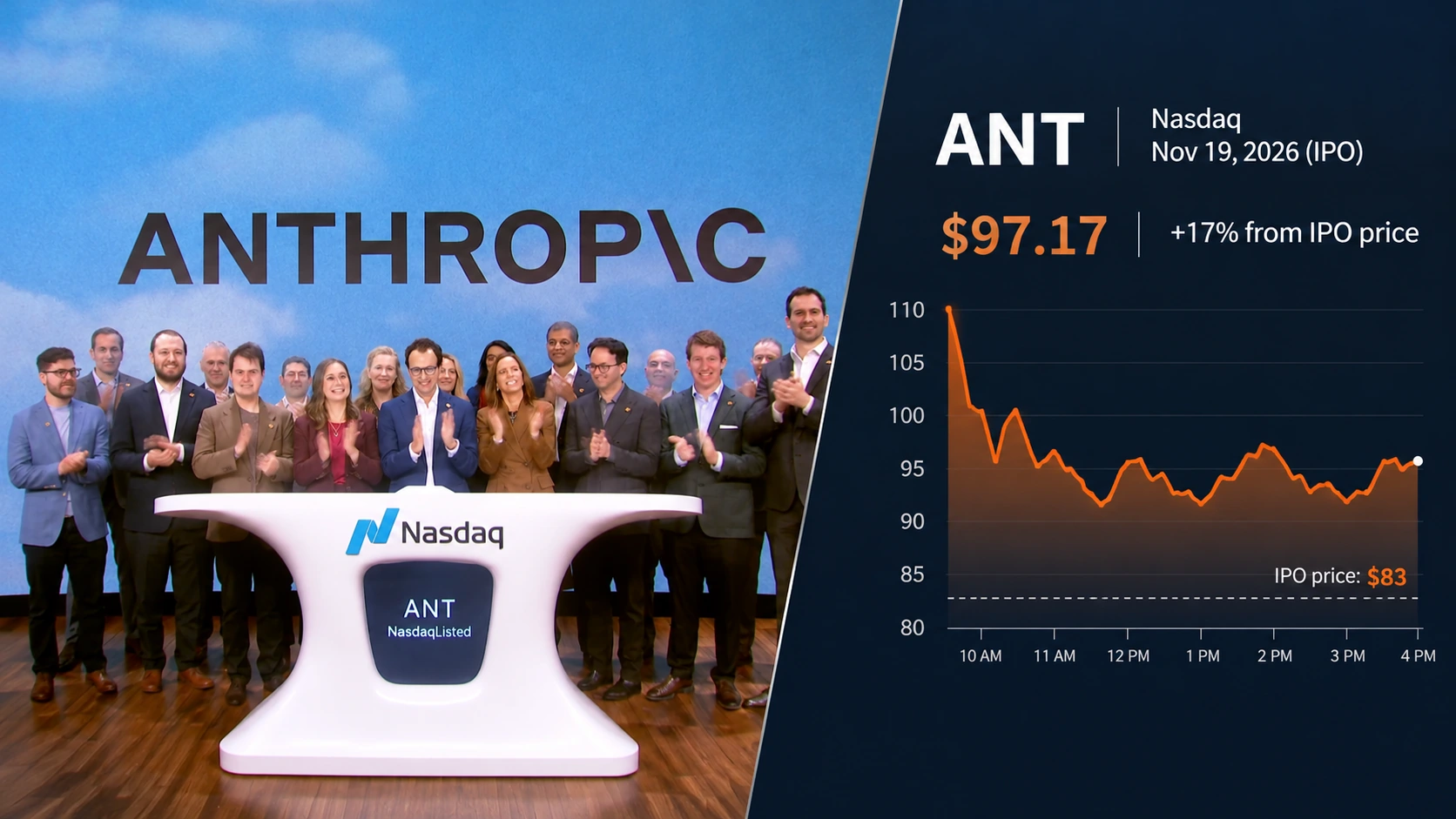
Anthropic made its Nasdaq debut on November 19, 2026, following what became the largest completed initial public offering in history by gross proceeds. Priced at $83 per share, the IPO closed the following day with approximately $93.5 billion in gross proceeds, surpassing the previous record set by SpaceX. Approximately $91.6 billion was attributable to shares sold by Anthropic, while a concurrent $26.0 billion private placement to seven technology partners brought the combined gross proceeds from both transactions to approximately $119.5 billion.1
The financing is extraordinary. Anthropic's governance arrangements may prove more consequential.
Unlike most publicly traded technology companies, Anthropic operates as a Delaware public benefit corporation (PBC). Its Long-Term Benefit Trust holds special rights to appoint a majority of the board, while a founder-controlled entity retains 50.1% of the voting power on general stockholder matters through a single share of Class F stock.2
These arrangements were designed to preserve Anthropic's long-term mission. Going public raises a harder question: whether they can influence decisions when commercial incentives conflict with AI safety.
The Promise and Limits of Public Benefit Governance
Delaware law requires PBC directors to balance shareholders' financial interests, the interests of those materially affected by corporate conduct, and the public benefit identified in the company's charter. Anthropic's stated purpose concerns the responsible development and maintenance of advanced AI for humanity's long-term benefit.23
This framework gives directors legal grounds to consider safety even when doing so may reduce near-term revenue. It does not, however, establish a clear hierarchy among competing interests.
Under Section 365 of the Delaware General Corporation Law, directors receive substantial protection for informed, disinterested balancing decisions that meet the statute's deferential standard. Nor does the public benefit obligation, by itself, create a fiduciary duty owed to every person potentially affected by the company's technology.3
Stockholders have a statutory enforcement mechanism, subject to ownership thresholds and the ordinary requirements governing derivative litigation. But the existence of a remedy is different from the practical ability to challenge a board's judgment.
PBC status therefore changes the framework within which directors make decisions. It does not determine which interests must prevail in a particular dispute.
An Unusual Division of Corporate Control
Anthropic's Long-Term Benefit Trust, established in 2023, holds the company's single Class T share. It generally elects and removes the directors occupying a majority of authorized board seats. One specified Class T seat is subject to additional procedures involving the board's nominating and governance committee and, in certain circumstances, Class E stockholders.4
The trust provides for five trustee positions, one of which was vacant at the time of the offering. Its trustees are intended to be financially disinterested, but the trust does not direct ordinary business operations or set day-to-day strategy.2
Meanwhile, a separate Founder LLC holds the single Class F share, carrying 50.1% of general stockholder voting power without corresponding economic rights. Together, the trust's board-election authority and the founders' voting rights substantially limit the influence of ordinary Class A shareholders.2
The distinction between these powers matters. The founders possess substantial shareholder voting control. The trust has an unusual role in determining who sits on the board. Neither arrangement, standing alone, establishes how individual model deployment decisions are reviewed or challenged.
That is where the governance question becomes operational rather than merely structural.
Can the Trust's Authority Be Changed?
The trust is not beyond amendment. Anthropic's governing documents establish a Trust Amendment Threshold covering specified changes to the trust, Class T rights, and redemption arrangements.5
Depending on the circumstances, amendments may require 80% approval from both authorized directors and serving trustees, a combination of founder, Class E and Class A approvals, or approval by 85% of outstanding Class A shares. The applicable route depends in part on whether Class F remains outstanding and whether trustees support the proposed change.5
Class E presents an additional complication. It is an employee voting class with limited rights and no economic interest, but no Class E shares were outstanding immediately after the offering.6 The practical operation of these voting requirements before any Class E shares are outstanding remains uncertain.
Class F is also subject to termination provisions, including a transition period triggered by a sustained reduction in the number of continuing founders.7
These are meaningful contractual arrangements, not simply statements of corporate purpose. Their limitations should nevertheless be understood precisely. The approval thresholds regulate changes to the governance structure; they do not themselves establish the procedures through which safety concerns reach directors or affect management decisions.
Where Commercial Pressure Becomes Concrete
Anthropic's financial commitments put the issue in perspective. Its prospectus disclosed approximately $900.9 billion in purchase and lease commitments, substantially related to computing infrastructure, including roughly $70.7 billion due within twelve months.2
Several participants in the concurrent Class N private placement are also important technology or infrastructure suppliers. Although Class N carries no voting rights, the overlap between commercial relationships and capital investment presents potential conflicts that Anthropic identifies in its disclosures.2
The company has already confronted a tangible safety-related deployment decision. Its Mythos model was made available through a restricted research preview under Project Glasswing rather than through unrestricted general release. Anthropic disclosed that deployment restrictions of this kind may have negatively affected short-term revenue.8
That disclosure does not establish an actual financial loss or reveal the board's deliberations. It does, however, illustrate how safety decisions can have commercial consequences.
As a public company, Anthropic will face continuing scrutiny of growth, infrastructure spending and financial performance. Its governance framework must operate in that environment, not outside it.
The Test Is in the Decision-Making Process
Anthropic's structure appears particularly suited to limiting certain forms of outside shareholder pressure. The more difficult question is whether it can provide equally effective oversight of decisions originating within the company.
The distinction is important. A trust may appoint directors without independently controlling the information those directors receive. A board may have authority to supervise management without having defined procedures for escalating serious model safety concerns. Neither circumstance proves that Anthropic lacks effective internal safeguards. Its public filings simply do not establish that governance rights alone guarantee operational oversight.
For other AI companies, the practical lesson is not necessarily to adopt Anthropic's corporate structure. It is to connect governance authority to specific decisions.
Boards overseeing advanced AI development should consider whether they receive independent safety assessments before consequential deployment decisions, whether material disagreements can be escalated beyond the teams responsible for commercial performance, and whether decisions to proceed despite identified risks are documented with a defensible rationale.
Those arrangements need not dictate every technical judgment. They should make clear who is accountable when a material risk is raised, what information must reach the board, and when further review is required.
Anthropic's IPO brings an ambitious governance experiment into public view. Its durability will be measured less by the protections written into its corporate documents than by the decisions those protections are capable of shaping.
Notes & Sources
- 01Anthropic, "Anthropic announces closing of initial public offering, including full exercise of underwriters' option… and closing of concurrent private placement," Nov. 20, 2026 See also Reuters via Euronext, Nov. 19, 2026 (record comparison at pricing) and SpaceX’s IPO closing announcement, June 15, 2026 (including full exercise of the overallotment option).
- 02Anthropic, PBC, Form 424B4 (prospectus dated Nov. 18, 2026), cover page and Prospectus Summary, pp. i, 6–19
- 038 Del. C. §§ 361–368 (Delaware Code Online)
- 04Form 424B4, "Our Governance Structure and Its Goals," p. 253 (Specified Class T Director)
- 05Form 424B4, pp. 253–254 (Trust Amendment Threshold)
- 06Form 424B4, pp. 258–259 (Class E voting and issuance)
- 07Form 424B4, p. 256 (Class F sunset and transition period)
- 08Form 424B4, p. 85 (Mythos / Project Glasswing disclosure)
This article is published by Meridian Strategy Partners LLC for general informational and research purposes only. It does not constitute legal, tax, financial, investment, securities, accounting, or other regulated professional advice.
Back to Insights